
Every Payment Is Personal
By the Paysoft Editorial Team
There is a moment Rika Kruger still talks about. She had just accepted a new job, one that came with a moving allowance. On the day of the move, she was sitting on the grass outside her old house, surrounded by packed boxes, waiting for the removal company to receive payment. The van was parked out front. The movers could not start loading until the funds had arrived. It was not a complicated payment. It was not a large amount. But in that moment, sitting outside watching the clock, it was everything.
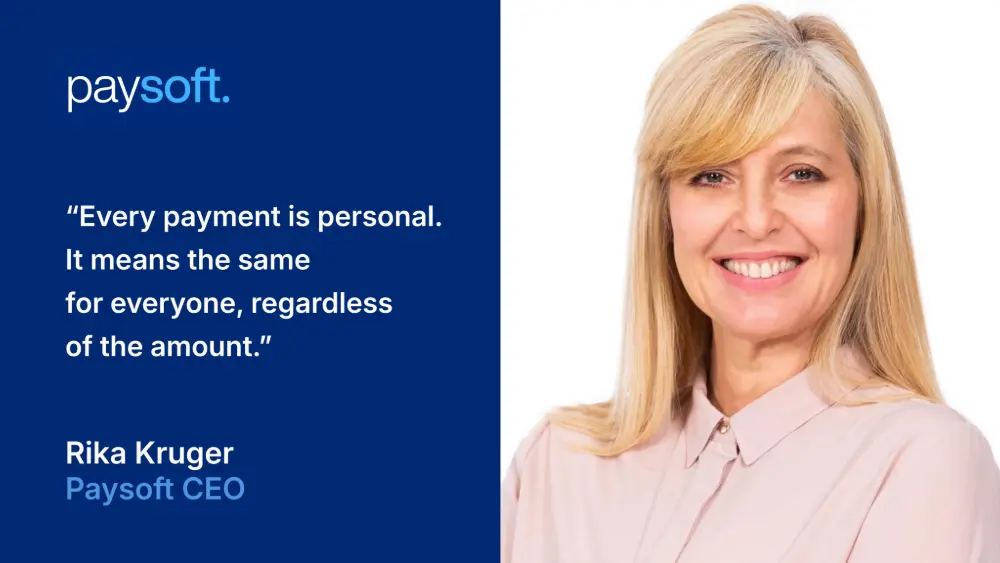
“That moment highlighted a simple truth,” she says. “Every single payment is personal. It means the same for everyone, regardless of the amount.”
That belief has shaped Paysoft from the beginning. Founded in 2012, the company has spent over a decade building payment infrastructure for South African businesses, and Rika has been at the centre of it. She leads with the same clarity she brings to that story: grounded, honest, and always thinking about the person on the other side of the transaction.
Where It Started
Paysoft did not begin with a business plan written in a coffee shop. It began with frustration. Every co-founder had run businesses themselves. They had struggled to pay staff on time. They had waited for inter-bank transfers that arrived late or not at all. They had dealt with banks charging more than R70 per real-time transaction and watched funds land inconsistently, sometimes a full day apart, leaving staff wondering whether they would be paid before the weekend.
“We faced common challenges,” Rika explains. “Struggling to pay staff and creditors on time, and collecting our own payments efficiently. These shared frustrations fuelled our desire to create better, smarter payment solutions.”
The vision they set out to build was a single, highly automated portal where a business could create, access and manage all their payment information without switching between systems. More than a decade later, that vision is still the foundation. The products have grown, the integrations have deepened, and the platform now serves everyone from large corporates to NPOs to small businesses running payroll on tight margins. But the intention has not changed.
Paysoft is the smart, human-first payment platform built for South African businesses. We make managing payments faster, friendlier and more affordable, with full visibility, built-in governance, and local support that is as dependable as your business.
Built Here, for Here
One of the things Rika speaks about most directly is how poorly global payment solutions map onto the South African reality. The lack of standardisation across local banks, the different naming conventions for the same products, the compliance requirements that keep evolving and the ongoing threat of fraud and cybercrime add up to a landscape that generic platforms were simply not designed for.
Paysoft supports over 90 existing banking and payroll file formats and can create new ones within minutes. The platform is completely bank-agnostic, meaning clients are not locked into a single financial institution. For payroll administrators and accountants managing multiple clients, a single login gives access to all relevant accounts in one place. In the SME space, where many businesses lack the internal resources to manage banking integrations and automated systems effectively, this matters enormously. Traditional solutions often offer limited ERP and accounting integrations, leaving businesses to close the gaps themselves. Paysoft addresses this across the board, with custom integrations for larger clients running systems like SAP or Oracle, and significant investment in automating payment workflows for accounting platforms like Xero.
The depth of what Paysoft has built is perhaps best illustrated by this: several of their competitors use Paysoft software to facilitate their own EFT processing. One South African bank runs its entire corporate payment system on a Paysoft base. It is the kind of trust that does not come from a sales pitch.
What Humanising Payments Actually Looks Like
Ask Rika what it means in practice to humanise payments, and she does not talk about product features first. She talks about a mother not being able to buy milk because a small wage did not arrive on time. She talks about afternoon shifts in certain industries, where workers simply will not return after the lunch break if the morning team has not been paid yet. She talks about a SARS payment that misses its deadline and lands a business with a fine it could not afford.
“Payments require a human touch,” she says. “A person who cares about the recipient and understands the impact an on-time payment can have.”
That shows up in very practical ways at Paysoft. The operations team maintains WhatsApp channels with processing banks, starting each morning at 05:00. They monitor every transaction in real time, watching which files are submitted, accepted, and pending. When cut-off times are approaching and they can see an authorised batch that has not moved, someone picks up the phone and calls the client. They do not wait to be asked.
“On several occasions, our team has waited late into the evening for clients to make real-time payments to ensure their employees are paid on schedule,” Rika says. “That is not a policy. It is just who we are.”
It is also worth noting that Paysoft often alerts banks to processing issues before the banks themselves are aware. Because the platform has full visibility across what is submitted and what is accepted, the team can see when files are not landing or when processing slows down, and they flag it immediately.
Real-Time Payments and PayShap: Already Here, Already Working
One of the most talked-about developments in the South African payments landscape right now is PayShap, the real-time rapid payments platform developed by BankservAfrica, recently renamed PayInc, in collaboration with the banking industry and driven by the South African Reserve Bank’s Vision 2025 strategy. Launched in March 2023, PayShap has already processed over 136 million transactions and registered more than 4.5 million ShapIDs nationally. Transaction limits have since been raised to R50,000 per transaction, and the platform runs 24/7 including weekends and public holidays.
Paysoft is already running PayShap transactions successfully across multiple clients. Through an automated API connection, Paysoft’s Immediate Payments service processes real-time payments on the PayShap banking rail, with funds landing in the recipient’s account within seconds. The routing is automatic: payments under R50,000 go via PayShap, while higher-value transactions run real-time, settling in under 15 minutes. Clients do not need to manage or choose the rail. Paysoft sends the instruction, and the platform handles the rest.
There is a practical resilience built into this too. Paysoft has developed a fail-safe for payments directed at non-participating banks, automatically rerouting those transactions as Same Day payments using the same API and service type. It is a small detail that makes a meaningful difference when a payment has to land and there is no room for error.
The next chapter in this story is PayShap Request, also known as Request to Pay, the collection mechanism that allows a payee to initiate a real-time interbank payment request which, once approved by the payer, clears instantly. PayInc launched PayShap Request in December 2024, and it is already live across several major South African banks. Paysoft is currently building its own Request to Pay capability and will be bringing it to clients shortly. For businesses that need to collect payments quickly and securely, without the friction of manual follow-up or the cost of traditional debit orders, this is a significant development.
“Every company in the payment space has a role to play in enhancing operational efficiencies, promoting economic resilience, and contributing to a more connected and competitive South African economy.”
Rika Kruger, Co-Founder and CEO, Paysoft
Looking Forward
The roadmap Rika describes is ambitious but grounded. Instant transfers, open banking, API ecosystem integrations, blockchain for low-cost cross-border transactions once the regulatory frameworks are in place, and practical applications of AI and machine learning in payment workflows are all being explored.
A new platform upgrade is in development that will allow partners and resellers to fully white-label the Paysoft experience, running independently under their own brand, with their own colours, logos and client emails, without needing Paysoft’s direct involvement in day-to-day operations. New features including automatic debit and credit reconciliation to accounting systems, electronic mandates, and self-service payouts are on the roadmap.
The human thread runs through the technology plans too. Paysoft has partnered with an NGO to deliver digital literacy and emerging technology workshops, making sure that staff and clients are equipped for what is coming rather than left behind by it.
“My wish for Paysoft, our clients, our competitors who are often our friends, and the South African economy is that we can create instant payment solutions that minimise the need for physical banking, cash handling, and manual processing, lowering transaction and administrative costs for everybody.”
Rika Kruger, Co-Founder and CEO, Paysoft
A Business Built on Relationships
When you ask Rika what drives her personally, she does not mention targets or milestones. She talks about the clients who have been on the platform since the beginning and are still there today. She talks about the messages she receives when something goes right for someone’s business.
“At Paysoft, our clients become like family to us. Nothing inspires me more than hearing from a client that we have made a real difference in their business, whether through cost savings, streamlining processes, or simply making their daily operations easier.”
In a market with well-funded competitors across the board, client retention like that is not accidental. It reflects something that does not show up in a feature comparison but matters enormously in practice: a business that consistently does what it says it will do, and picks up the phone when it matters.
“The fact that they are still with us makes me believe that our clients know that we live our values,” Rika says.
Trust. Transparency. Empowerment. For Rika Kruger and the Paysoft team, those are not words on a wall. They are the standard applied to every transaction, for every client, every single day.